
We are pleased to share the online publication of CERG/EBS/UDC Sustainable Uttlesford Report
Foreword
Vicky Reed (Uttlesford District Council)
Councillor Neil Reeve (Uttlesford District Council and Sustainable Uttlesford)
Uttlesford is a thriving rural district in north-west Essex, encompassing four historic market towns and around 100 villages and hamlets. Situated between London and Cambridge and home to London Stansted Airport, it combines a robust economy with beautiful landscapes, rich heritage and vibrant communities. Uttlesford is a place where nature, enterprise and innovation flourish together. Yet, like communities across the country, we face significant challenges associated with climate change, biodiversity loss, energy security and the need to build resilience in an increasingly uncertain world.
Meeting these challenges requires more than policy alone. It requires collaboration, innovation and the active participation of people and organisations across the district. Above all, it requires strong partnerships that can connect strategic ambitions with practical action and empower local people to help shape the future of the places they care about.
Since its establishment through the support of Uttlesford District Council and the Zero Carbon Communities programme, Sustainable Uttlesford has become an important catalyst for sustainability action across the district. Through community engagement, partnership building and project development, it has evolved from a funded initiative into a respected network working towards a shared vision of a more sustainable and resilient Uttlesford.
This report marks an important milestone in that journey.
Drawing on a series of workshops involving representatives from the public, private, voluntary, academic and community sectors, it reflects on achievements to date while exploring the future role that Sustainable Uttlesford can play in a rapidly changing environmental, social and institutional landscape.
A central message emerging from the report is the importance of community leadership. Lasting change happens when local people are empowered to shape their futures and when organisations can connect ideas, resources and opportunities. The report identifies a growing role for Sustainable Uttlesford in the vital space between policy and community action. Here, it can help translate ambition into delivery, connecting residents, community groups, parish councils, businesses, educational institutions and public bodies around shared goals.
The workshops also highlighted that sustainability is not simply a technical challenge. It is deeply connected to people’s relationships with the places they inhabit. Strong emotional connections to landscapes, villages, towns and ecosystems can inspire stewardship, participation and long-term commitment. Uttlesford’s landscapes and communities are therefore not only assets to be protected, but foundations upon which a thriving future can be built.
Another powerful theme was the role of collective imagination. Communities are more likely to act when they can share positive visions of the future. Imagination helps people move beyond reacting to challenges and towards creating places that are more resilient and more connected with nature. Storytelling, creativity and participation therefore have an important role in building confidence, agency and optimism alongside practical action.
This report arrives at a time of significant change within local government, environmental policy and funding arrangements. While such transitions bring challenges, they also create opportunities to strengthen partnerships, rethink existing models and develop new approaches capable of delivering lasting impact. The recommendations set out a framework through which Sustainable Uttlesford can continue to evolve as an independent, resilient and influential organisation supporting nature recovery, climate action and community wellbeing across the district.
We are encouraged by the ambition, creativity and commitment reflected throughout this report and thank all those who contributed their time, expertise and insight to the workshops and to the wider work of Sustainable Uttlesford. Together, through partnership, imagination and a shared commitment to place, we have an opportunity to build a more resilient, sustainable and nature-rich Uttlesford for current and future generations.
Executive Summary: Strategic Conclusions and Recommendations
Supported by the University of Essex’s Innovation Fund, the Sustainable Uttlesford (SU) strategic workshops brought together regional partners from Uttlesford District Council (UDC), Sustainable Uttlesford, the University of Essex Business School (EBS), the Cultural Engine Research Group (CERG) and the University of Essex’s School of Life Sciences, alongside contributors from Essex County Council and Essex Wildlife Trust (see Appendix One for a full list of participants).
Held over two days, the workshops examined how Sustainable Uttlesford can move beyond its current UDC seed-funded phase towards a more independent, sustainable and strategically connected organisation. Discussions were structured around four interconnected questions:
- Can you imagine the future of Sustainable Uttlesford?
- How should Sustainable Uttlesford be organised and funded?
- What distinctive role can Sustainable Uttlesford play in biodiversity and nature recovery?
- How can Sustainable Uttlesford build the partnerships, participation and community reach necessary to deliver its ambitions?
Based on EBS and CERG research, a central proposition running through the workshops was that Sustainable Uttlesford can operate effectively at the mezzo-level: the space between high-level policy and strategy on the one hand, and the hyper-local activities of communities, organisations and individual citizens on the other. The mezzo-level is understood here not simply as an organisational tier, but as an organisational principle for connecting local imagination, policy, resources and expertise to realise community empowerment.
The workshops therefore explored how Sustainable Uttlesford might become an enabling infrastructure for local sustainability action: creating the conditions through which locally generated ideas can become viable projects; translating policy into practical opportunities; connecting communities with resources and expertise; and building partnerships across institutional boundaries.
The two-day process generated a framework of short-term and medium-term actions intended to secure the long-term sustainability of Sustainable Uttlesford itself, while also laying the foundations for supporting wider nature recovery, community energy and low-carbon initiatives across the district.
Key Findings
A high degree of consensus emerged across all four workshops that Sustainable Uttlesford has reached an important transition point in its development. Originally established through support from Uttlesford District Council and catalysed through the Zero Carbon Communities Fund, SU has successfully built credibility, developed strong partnerships and achieved growing recognition across the district.
However, participants recognised that changing governance arrangements, evolving public policy priorities and increasing funding uncertainty now require the organisation to evolve from a largely volunteer-led and council-supported initiative into a more independent, resilient and strategically capable organisation.
Across all discussions, a common conclusion emerged: Sustainable Uttlesford’s greatest value may not lie in directly delivering projects itself, but in acting as an enabling organisation operating at the mezzo-level between policy and community action.
The workshops therefore proposed that Sustainable Uttlesford should increasingly position itself as:
A District-Wide Enabling Infrastructure for Sustainability, Nature Recovery and Community Resilience
In practical terms, this means creating the conditions through which residents, community groups, parish councils, schools, businesses, landowners and public organisations can access the resources, expertise, funding, evidence and partnerships required to deliver meaningful local action.
Participants repeatedly identified a gap between strategic ambitions and local delivery. National biodiversity targets, Local Nature Recovery Strategies, net-zero commitments and climate resilience frameworks all depend upon implementation at local levels. Equally, community organisations often possess significant commitment, local knowledge and enthusiasm but lack the capacity, funding, technical support and strategic connectivity necessary to translate aspirations into sustained action.
The workshops suggest that Sustainable Uttlesford is uniquely positioned to occupy this intermediary role. Rather than duplicating the work of existing organisations, SU can provide coordination, translation, amplification and support across the wider sustainability ecosystem.
Building Organisational Resilience
One of the strongest themes emerging from the workshops was the need for greater organisational resilience. Local government reorganisation, financial pressures on public institutions, evolving responsibilities within Essex County Council and changing national funding arrangements all point towards a future in which communities and local partnerships will require greater independence and capacity.
Importantly, participants viewed independence not as separation from public bodies, but as organisational maturity. A resilient Sustainable Uttlesford would remain a trusted partner of local authorities, universities, environmental organisations and community groups while developing its own governance, identity and funding base.
The workshops therefore supported the development of an organisational model characterised by:
- Independent governance.
- Strong strategic partnerships.
- Professional staffing and leadership capacity.
- Volunteer participation and community ownership.
- Multiple income and funding streams.
- Robust monitoring, learning and evidence systems.
- Strong communications and engagement capabilities.
Participants consistently identified dedicated staff capacity as the single most important requirement for the next phase of development. While governance structures and legal models remain important, the transition will depend largely upon SU’s ability to secure the people, skills and resources required to lead organisational development, partnership building and programme delivery.
Nature Recovery, Climate Action and Community Wellbeing
The biodiversity workshops identified a significant opportunity for Sustainable Uttlesford to become a leading local partner in delivering the Essex Local Nature Recovery Strategy. Participants envisaged a role focused less on direct ecological delivery and more on connecting communities, supporting parish-level action, facilitating citizen science, improving local nature literacy and helping translate strategic environmental objectives into measurable local outcomes.
A notable feature of the discussions was the extent to which environmental action was linked to broader social and economic outcomes. Climate action, biodiversity recovery, community energy and environmental stewardship were consistently viewed not as isolated objectives, but as contributors to healthier communities, stronger local economies, improved wellbeing, enhanced civic participation and greater resilience.
Imagination, Culture and Emotional Connection to Place
The workshops also highlighted the importance of imagination, storytelling and emotional connection to place as essential components of sustainable development.
Participants argued that successful environmental action requires more than technical solutions and policy frameworks. Communities must be able to imagine positive futures for the places they inhabit and develop meaningful connections with those futures. A recurring theme throughout the discussions was that belonging, identity and stewardship are critical foundations for long-term environmental action.
Emerging initiatives such as the River’s Return documentary theme of collective imagination, demonstrate how creativity, culture and emotional engagement can help communities participate more effectively in shaping the future of their landscapes and settlements. In this sense, cultural activity was understood not as an optional addition to sustainability work, but as part of the infrastructure through which sustainable futures can be created.
The Five Functions of Sustainable Uttlesford
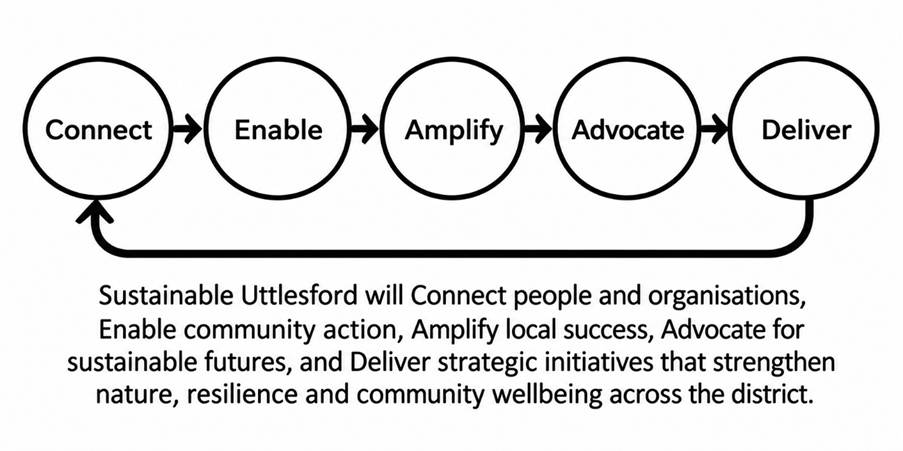
Taken together, the workshops suggest that Sustainable Uttlesford’s future role can be understood through five interconnected functions:
Connect
Bring together communities, parish councils, businesses, landowners, schools, public bodies, funders and specialist organisations to build relationships, partnerships and opportunities.
Enable
Provide access to funding, expertise, advice, training, evidence and organisational support that enables others to deliver projects and programmes.
Amplify
Celebrate, communicate and strengthen existing activity, increasing visibility, sharing learning and promoting local leadership across the district.
Advocate
Act as a trusted voice for nature recovery, climate action and community resilience, helping shape policy, attract resources and represent community interests.
Deliver
Lead projects and programmes where SU can add distinctive value through coordination, engagement, innovation, partnership management and evidence generation.
Strategic Conclusion
The principal conclusion of this report is that Sustainable Uttlesford should move confidently towards becoming an independent, professionally supported and strategically connected mezzo-level organisation.
Its primary role should be to act as enabling infrastructure for sustainability, nature recovery and community resilience across the district, helping bridge the gap between policy ambitions and local action while fostering stronger partnerships, wider participation and greater community capacity.
If successfully developed, Sustainable Uttlesford has the potential to become a recognised district-wide platform for community-led sustainability action and a leading example of how local leadership, collective imagination, emotional connection to place and cross-sector collaboration can be combined to deliver meaningful environmental, social and economic outcomes.
The challenge for the next twelve months is not to define additional ambitions, but to establish the governance arrangements, partnerships, organisational capacity and funding mechanisms required to translate existing ambitions into long-term and measurable impact.
Full Report