
Campaign to host public event on 4 February 2027 at the Minories Café, building on the success of the second Wild Essex Imaginarium community ecology event in February 2026.
Colchester, Essex, 23 November 2026
A group of local residents, gardeners, artists and researchers has called on the team planning a new bus interchange at Painters Yard in Colchester to carry forward the legacy of Beth Chatto’s Meanwhile Garden.
The Garden was planted on the rubble of the former bus station and the DIY arts venue that followed it, The Waiting Room, and opened in July 2024. It combines ornamental planting with plants that have simply grown there on their own.
Wildlife observations during its first full summer recorded rare bee species and insects, including the Spined Mason Bee, the Little Blue Carpenter Bee and the Pantaloon Bee.
The campaign is coordinated through the Wild Essex Imaginarium, a project launched at the University of Essex’s Business School in 2025. It argues that better public transport and a stronger living landscape are not competing priorities: they should be delivered within the same project.
Organisers were clear that this is not an opposition campaign.
“We support the bus interchange”
“We support the bus interchange,” said campaign organiser David Gates, the Meanwhile Gardener. “We’d like to see more electric buses. But what we are asking is that, before the landscape is fixed, the council works with us to record what is already there, and to design a biodiverse, accessible public landscape that carries the Meanwhile Garden’s legacy into a deliberately managed wild setting.”
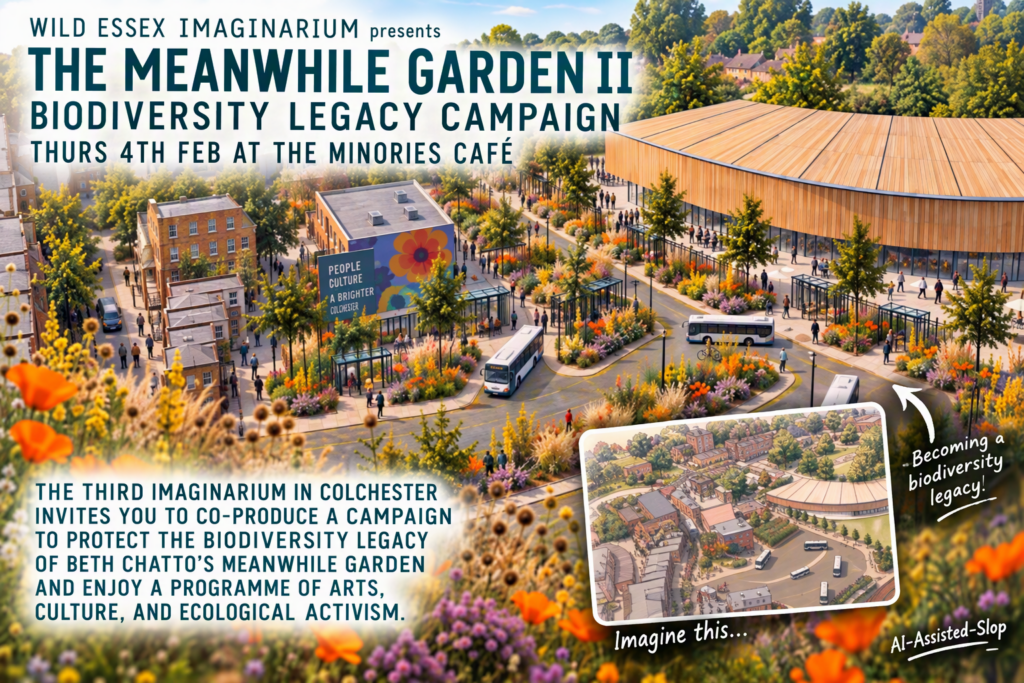
What the campaign is asking for
Dr Tony Sampson, who leads the Wild Essex Imaginarium, said the campaign was “seeking a clear route into the project while decisions were still open. We are asking Team Colchester (the council partnership developing the proposals) to carry the garden’s ecological, participatory and design legacy into the Painters Yard project before landscape decisions are fixed.”
Following the announcement of their plans during the consultation window in early November, the campaign will now be asking Team Colchester for a named project contact and clear decision dates. “We will invite the team to a community-focused design and ecology workshops organised by the Imaginarium, where we can discuss plans before the design process begins,” said Dr Sampson.
The campaign team acknowledges that the garden is subject to a short-term agreement (meanwhile lease) that lets vacant land be occupied temporarily while a tenant prepares for redevelopment, or waits on planning. But Mr Gates “wants all future descriptions to acknowledge the existing garden rather than call the wider site ‘vacant’ or ‘empty.’ The garden’s value lay in what had established itself on the site since planting began.”
“We also want to develop an interim protocol to avoid unnecessary disturbance to habitats while decisions are made,” he continued.
The campaign contends that protecting the legacy of the garden is a mutual gain for all of Colchester: built into a costed stewardship plan with specialist care and monitoring, the community gains another wonderful attraction in the town, helps nature thrive in urban spaces, and significantly benefits from planting that needs no watering during droughts.
A different kind of campaign
The Wild Essex Imaginarium is not a conventional campaign platform. Launched at The University of Essex’s Business School (EBS) in 2025, Dr Sampson describes it as “providing spaces for collective community imagination, bringing together researchers, artists, ecologists, community advocates and policymakers.”
Dr Sampson said the Imaginarium “offered a practical way for the community to contribute evidence and local knowledge to the design process.”
The second Wild Essex Imaginarium event, a sell-out, was held at the Minories in February 2026. That event presented the Meanwhile Garden through the idea of ecological “urban disturbance.” It drew attention to statutory commitments to the Local Nature Recovery Strategy and celebrated the biodiversity net gain of the garden.
The campaign now draws on this framework to explore what urban nature recovery might mean in the context of a bus interchange.
“The garden’s function is not to preserve or control nature, but to allow disturbance to become a catalyst for renewal. It is a living experiment in what happens when you let nature and people co-produce a space,” Mr Gates said. “The interchange is an opportunity to carry that experiment forward, not to erase it.”
Three stages of co-production
The campaign will work in three stages.
The first stage has already logged the campaign with Essex Highways before the consultation closed. The organisers now request that the council name a project contact and provide key decision dates.
The second is the Imaginarium event on 4 February 2027 at the Minories Cafe, which will invite attendees to co-produce the campaign while enjoying with a programme of music, art and science. Council representatives will be invited.
The third comprises two linked workshops hosted by the Wild Essex Imaginarium. The first will explore design principles: what already exists on the site, how to combine different types of planting so a wide range of species can thrive, how to make routes and seating accessible, and how to plan for drought, shade and drainage from the start. The second will address ecology and long-term care: what surveys exist, which habitats are worth protecting, how the design responds to the Essex Local Nature Recovery Strategy, and who will look after the landscape afterwards.
Dr Sampson said, “the Imaginarium event at the Minories and the subsequent workshops would be open to anyone with an interest in the site, not only specialists.”
Not asking for everything to be preserved
The campaign is explicit that not everything can or should be retained. Space for bus movements, boarding and emergency access will constrain what is possible and may limit proposals.
Instead, the campaign is proposing a hierarchy: keep in place where possible, integrate partially where not, continue nearby where neither is feasible, and document any recreation rather than promising total preservation.
Campaign representatives note that neither alignment with the Local Nature Recovery Strategy nor biodiversity net gain compliance necessarily secures this garden in place, and that brownfield status alone does not establish priority habitat. However, against a backdrop of serious specie decline and shrinking habitats throughout Essex, and across the UK, this campaign offers a way to imagine things differently.